

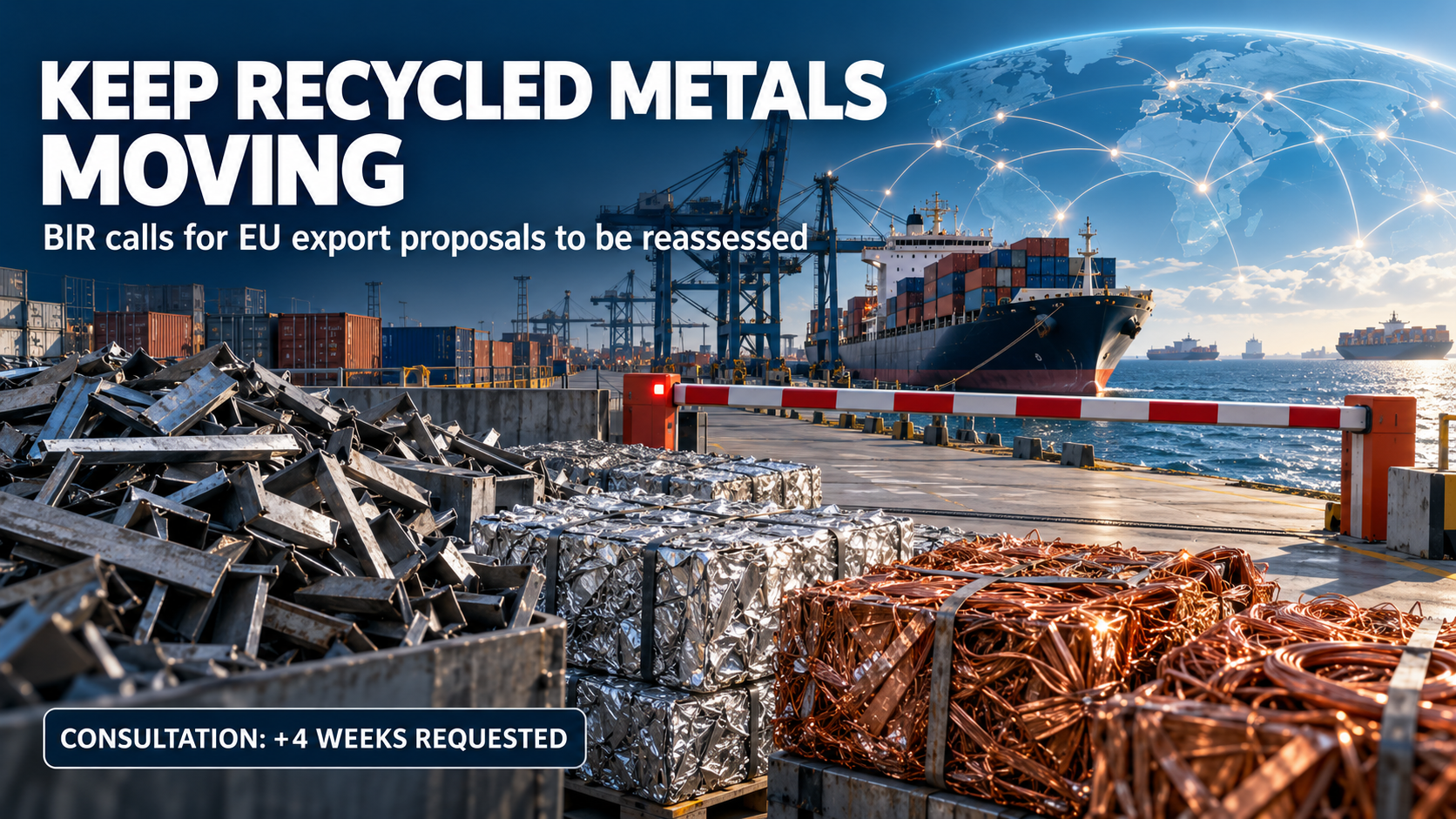
BIR has called on the European Commission to reconsider proposed restrictions on exports of recycled metals to major non-OECD markets and to extend its consultation by four weeks, giving affected countries and territories more time to address the Commission’s findings and provide additional evidence.
BIR has submitted its official response to the European Commission’s consultation on the draft list of non-OECD countries that would be authorised to import certain non-hazardous waste from the EU under the Waste Shipment Regulation.
Under the Commission’s current proposal, a number of major non-OECD markets would be excluded as destinations for exports of ferrous and non-ferrous recycled metals from the EU. BIR is calling for a reassessment of the proposed restrictions and of the evidence and legal reasoning underpinning them.
Crucially, BIR has also requested a four-week extension of the consultation period, to at least eight weeks, with a deadline no earlier than 13 November 2026. The additional time would allow affected countries and territories to coordinate with ministries, regulators and facilities, respond to the Commission’s findings and submit supplementary evidence before the final list of authorised destinations is established.
BIR fully supports the objective of ensuring that exported materials are managed in an environmentally sound manner. At the same time, the world recycling organisation warns that the proposed restrictions could disrupt established recycling supply chains, distort markets and restrict access to recycled metals in importing countries.
European recyclers already supply the majority of their recycled metal output to European industry. International markets nevertheless remain essential when European demand or technically suitable treatment capacity cannot absorb the grades and volumes available.
Restricting access to established international markets therefore does not, in itself, create additional recycling capacity or demand within Europe. Instead, BIR is concerned that restrictions could weaken the economic conditions that underpin collection and recycling and, ultimately, the future availability of recycled materials.
BIR’s submission builds on its official statement of 23 September 2026 and calls on the European Commission to ensure that its final assessment takes full account of the evidence available and gives affected countries sufficient opportunity to respond.
title: Circular Technology with AI.
